Why Transmission Problems Aren’t Always the Transmission
Why Transmission Problems Aren’t Always the Transmission
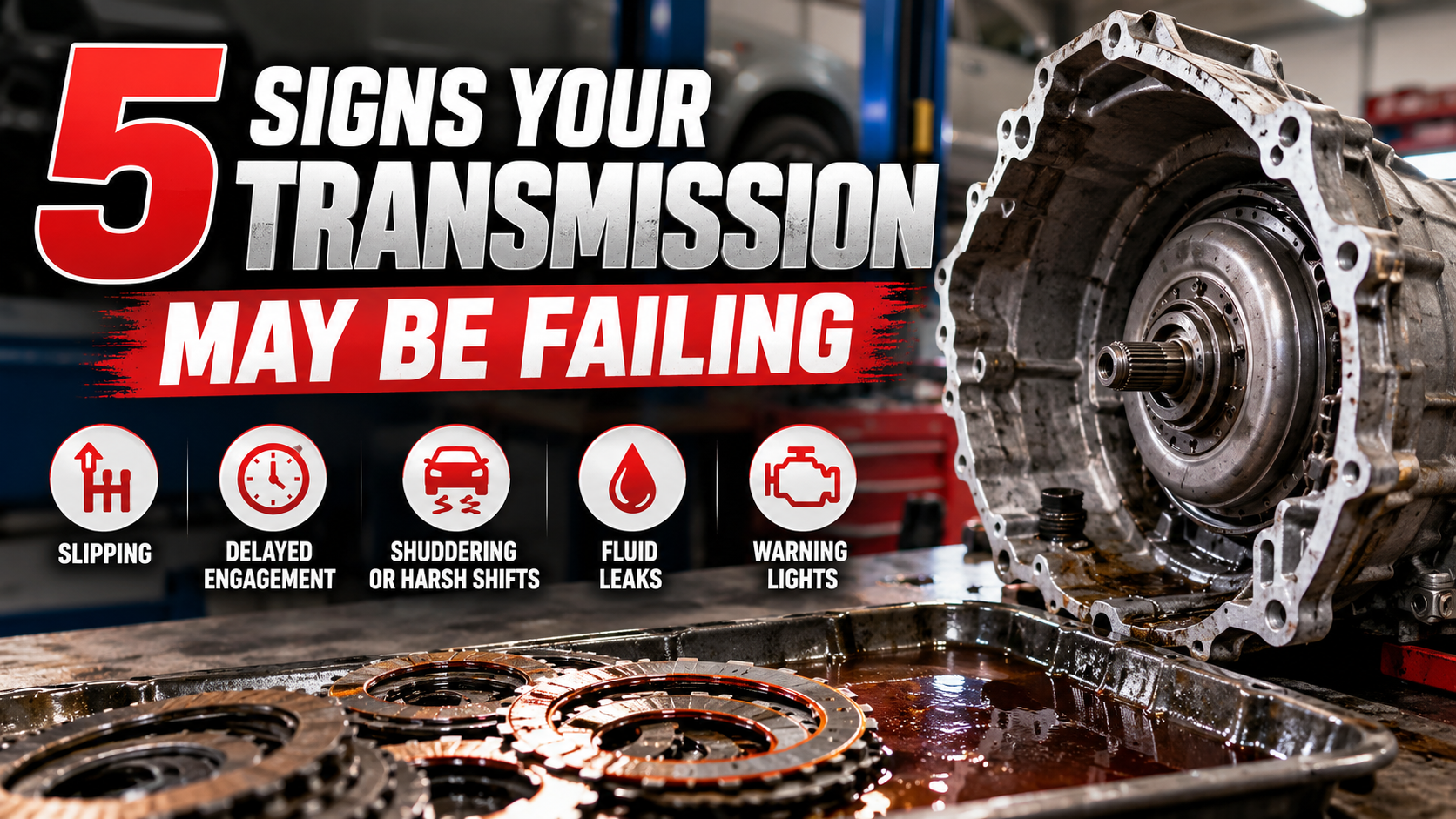
When a vehicle starts slipping, shuddering, shifting hard, hesitating, or behaving strangely when accelerating, it's easy to assume the transmission is failing.
Sometimes it is.
But many systems on a modern vehicle work together to determine how the vehicle accelerates, shifts, and transfers power to the wheels. A problem somewhere else can create symptoms that feel remarkably similar to a transmission problem.
That's why at Tex's Auto Care, we believe in diagnosing the problem before recommending the repair.
A transmission symptom gives us a place to start looking. It doesn't automatically tell us what part needs to be replaced.
An Engine Problem Can Feel Like a Transmission Problem
The engine and transmission work together. If the engine isn't producing smooth, consistent power, the driver may feel the problem through the drivetrain and assume the transmission is responsible.
An engine misfire is a good example.
Under load, a misfire can sometimes feel like a shudder, hesitation, or jerking sensation. Depending on when it occurs, a driver may describe it as the transmission slipping or the torque converter shuddering.
Other engine-related problems can affect how a vehicle feels during acceleration as well.
Before condemning the transmission, it may be necessary to determine whether the engine is operating correctly.
A Shudder Doesn't Automatically Mean the Torque Converter
Torque converter clutch shudder is a real problem on some vehicles, but not every shudder comes from the torque converter.
A vibration or shudder under acceleration could potentially involve:
- Engine performance
- Ignition or fuel delivery
- Engine or transmission mounts
- Axles or CV joints
- Driveshaft components
- Tires or wheels
- Other driveline components
- The transmission or torque converter
The conditions under which the symptom occurs can provide important clues.
Does it happen at a particular speed? Only under load? During a shift? When the torque converter clutch applies? During light acceleration? Does engine speed change when it happens?
Those details help us determine where testing should begin.
Harsh Engagement Doesn't Automatically Mean Internal Transmission Failure
A hard engagement when shifting into Drive or Reverse can certainly be caused by a transmission problem.
But it can also be influenced by other conditions.
A worn or broken engine or transmission mount, for example, may allow excessive drivetrain movement when the transmission is placed into gear. To the driver, that movement may feel like the transmission is engaging extremely hard.
Engine idle problems can also affect engagement quality.
The important point is that the symptom and the cause aren't always the same thing.
Modern Transmissions Depend on Information From the Rest of the Vehicle
Modern automatic transmissions don't operate independently.
The transmission control system may use information from numerous sensors and modules to determine when and how the transmission should shift.
Depending on the vehicle, that information may include things such as:
- Engine speed
- Vehicle speed
- Throttle or accelerator position
- Engine load
- Transmission input and output speed
- Fluid temperature
- Brake application
- Wheel-speed information
- Requested engine torque
If the information being supplied to the control system is incorrect, transmission operation may be affected even though the mechanical components inside the transmission aren't necessarily the original cause.
This is one reason proper diagnosis often involves looking beyond the transmission itself.
Electrical Problems Can Cause Transmission Symptoms
Modern transmissions contain electronically controlled solenoids, sensors, wiring, and control modules.
An electrical problem can sometimes cause:
- Harsh shifts
- Delayed shifts
- Incorrect gear operation
- Loss of certain gears
- Warning messages
- Fail-safe or limited-operation modes
The cause could potentially be inside the transmission, but it could also involve wiring, connectors, power or ground circuits, sensors, or another part of the vehicle's control system.
Replacing a transmission doesn't repair an electrical problem somewhere else on the vehicle.
That's why testing matters.
Low System Voltage Can Create Strange Problems
Modern vehicles are extremely dependent on stable electrical power.
A weak battery, charging-system problem, poor connection, or voltage issue can sometimes contribute to unusual electronic behavior.
That doesn't mean every transmission complaint needs a battery.
It means electrical system condition can be relevant when diagnosing electronically controlled systems, particularly when multiple modules are reporting unusual faults or communication problems.
Good diagnosis means looking at the evidence rather than assuming the most expensive component is responsible.
A Fluid Leak Doesn't Always Mean the Transmission Itself Is Leaking
Seeing red or oily fluid underneath a vehicle understandably raises concern about the transmission.
But identifying where the fluid is actually coming from matters.
A transmission-related leak might come from a cooler line, pan gasket, axle seal, electrical connector or pass-through seal, case seal, or another serviceable area depending on the transmission design.
Other vehicle fluids can also be mistaken for transmission fluid.
The location and source of the leak need to be identified before deciding what repair is necessary.
And even when the transmission is leaking, a leak does not automatically mean the transmission needs to be rebuilt or replaced.
A Transmission Trouble Code Isn't a Diagnosis
This is one of the biggest misunderstandings surrounding modern vehicle diagnosis.
A diagnostic trouble code tells us that a control module detected something outside the expected operating range.
It doesn't necessarily tell us which part failed.
For example, a transmission-related code may indicate that the computer detected:
- An unexpected gear ratio
- Excessive torque converter clutch slip
- A pressure-control problem
- A speed-sensor problem
- A solenoid electrical fault
- A communication problem
That's valuable information, but it's usually the beginning of the diagnostic process, not the end.
Suppose a computer detects that the transmission isn't achieving the gear ratio it expects. There can be a major difference between knowing the transmission is slipping and knowing why it is slipping.
The cause might be hydraulic, electrical, mechanical, fluid-related, or a combination of problems.
A trouble code points us toward a system or condition that needs testing. It doesn't automatically tell us which part to replace.
Even an Internal Transmission Problem Doesn't Automatically Mean a Complete Transmission
There is another misconception worth addressing.
Sometimes diagnosis confirms that the problem really is transmission-related.
That still doesn't automatically mean the entire transmission needs to be replaced.
Depending on the transmission and the failure, the appropriate repair could involve:
- An external sensor or solenoid
- Wiring or electrical repair
- A leak repair
- A valve-body or hydraulic-control repair
- A torque converter
- Internal transmission repair
- A complete rebuild
- A remanufactured or replacement transmission
Which option makes sense depends on what failed, the condition of the rest of the transmission, vehicle mileage and condition, parts availability, repair options, and the economics of the repair.
The purpose of diagnosis is to determine what problem we're actually trying to solve.
What Does Transmission Diagnosis Involve?
There isn't one single test that diagnoses every transmission problem.
The diagnostic process depends on the vehicle and the complaint, but it may include:
- Talking with the customer about exactly what the vehicle is doing
- Verifying the symptom
- Performing a complete system scan
- Reviewing diagnostic trouble codes and related data
- Inspecting fluid level and condition when applicable
- Checking for leaks
- Road testing the vehicle
- Monitoring scan-tool data while the symptom occurs
- Evaluating engine operation
- Inspecting related electrical or driveline systems
- Checking manufacturer service information
- Performing transmission-specific electrical, hydraulic, or mechanical testing when necessary
Not every vehicle requires every one of these tests.
The testing should follow the evidence.
Why Verifying the Complaint Matters
One of the most useful pieces of diagnostic information is understanding exactly when the problem occurs.
“It's shifting funny” can mean very different things to different people.
We may want to know:
- Is it cold or warmed up when it happens?
- What speed are you traveling?
- Is it during acceleration or steady cruising?
- Does it happen during a particular shift?
- Does engine RPM increase?
- Is there a vibration or an actual change in engine speed?
- Does it happen every time or only occasionally?
- Did a warning light or message appear?
The more accurately we can reproduce the condition, the better chance we have of identifying its cause.
Sometimes that means the vehicle needs to be driven long enough to reach operating temperature or tested under the conditions where the customer experiences the problem.
Why We Diagnose Before Recommending a Transmission
A transmission is one of the most expensive components on many vehicles.
We don't believe it should be condemned simply because the vehicle has a transmission-related symptom or trouble code.
Sometimes testing confirms a serious internal transmission failure.
Sometimes it finds a much smaller problem.
And sometimes the transmission turns out not to be the source of the complaint at all.
The goal isn't to prove that a vehicle needs a transmission. The goal is to find out what's actually wrong with the vehicle.
That's why diagnosis comes first.
Having What Feels Like a Transmission Problem?
If your vehicle is slipping, shuddering, shifting hard, hesitating, leaking fluid, displaying a transmission warning, or simply doesn't feel right, Tex's Auto Care in Lawrenceburg, Kentucky can help determine what's causing the problem.
Whether the problem turns out to be inside the transmission or somewhere else on the vehicle, we'll start by gathering the information and performing the testing needed to determine the appropriate next step.
Contact Tex's Auto Care to schedule a Transmission Diagnostic Evaluation.